How to Plan a Multi-Race Season: A, B, and C Races Explained
Racing more than once a year needs a different mindset than chasing one big goal. Here's the A/B/C framework, explained simply.
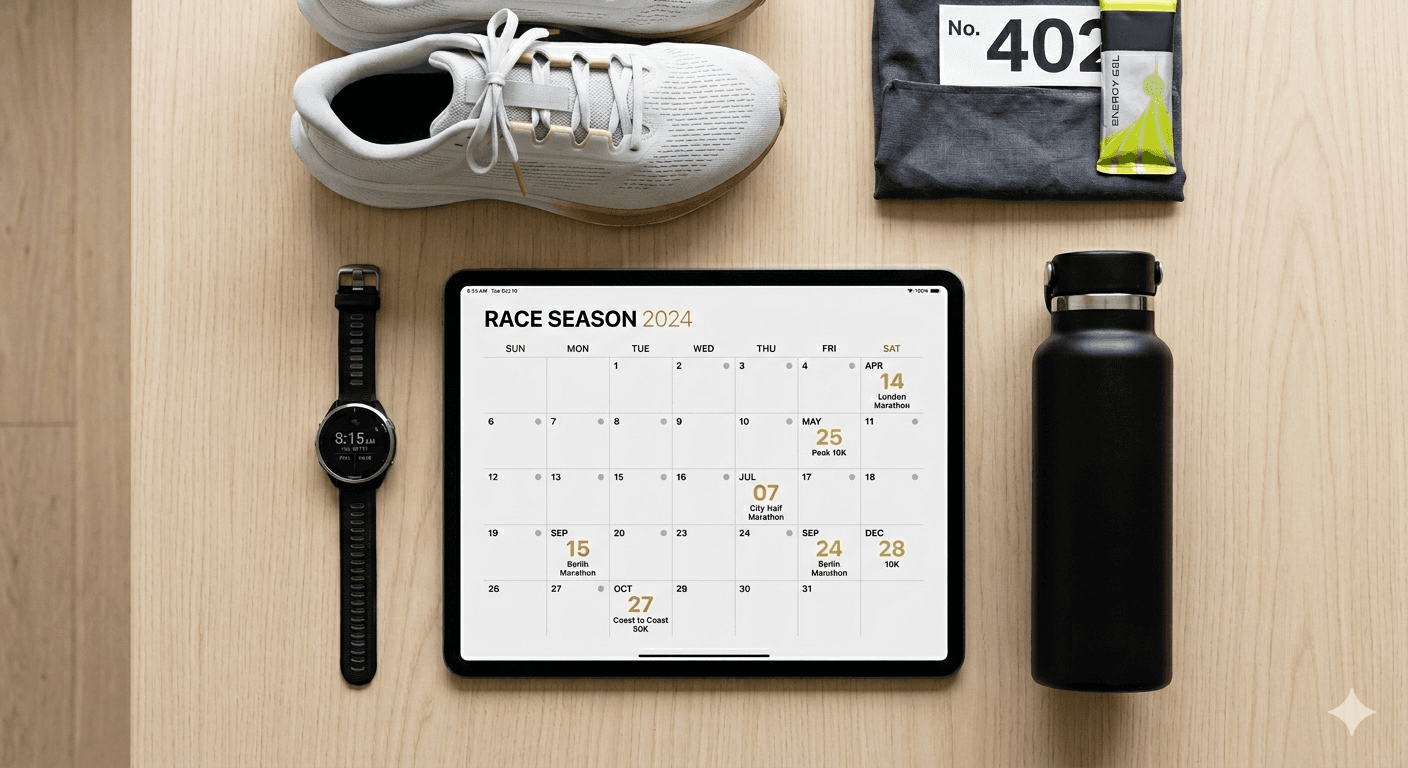
Most serious amateur athletes aren't racing once a year. They're racing five, eight, sometimes twelve times. Without some kind of priority system, every race ends up feeling equally important, your training turns reactive, and by September you're either overtrained or wondering why none of it actually paid off. The A/B/C framework fixes this.
What A, B, and C races actually mean
It's simpler than it sounds:
- A races are your big goals for the season. The ones you build your whole training block around, taper fully for, and race at your absolute best. Most people have one or two of these a year.
- B races matter, but they're not the main event. You race them hard, but with a shorter taper, and you accept the performance won't be your peak. Think of them as fitness checks on the way to an A race.
- C races are the fun ones. Social, low-pressure, sometimes zero taper at all. You're basically using them as a hard training session that happens to have a bib number.
Here's the part people miss: this isn't about which races matter more as events. It's about how much you prepare for each one and how much you expect from yourself on the day.
How to actually assign priorities
Start with your A races first, then build everything else around them. A races should be:
- At least 8-12 weeks apart, more if it's a longer distance
- Given a real taper, 1-3 weeks depending on the event
- Backed by a full training block, not squeezed in between other big races
Once your A races are locked in, the rest falls into place more naturally. A B race 3-4 weeks before an A race makes a great fitness check. A C race somewhere in the middle of a block keeps you sharp without messing with your training.
The mistake almost everyone makes
The second people learn this framework, they want to call everything an A race. That defeats the whole point. You physically and mentally can't peak over and over again in close succession. Chasing peak performance every few weeks is basically a guaranteed route to burnout, injury, and a flat year.
Be honest with yourself about what each race actually is. If it's a local 5K in February, it's probably a C race. That's completely fine. It doesn't need to be more than that.
Building your training around the calendar
Once priorities are set, work backward from each A race to plan training. A pretty standard 12-week block looks like:
- Weeks 1-4: Base building, mostly volume and aerobic work
- Weeks 5-8: Build phase, intensity comes in, race-specific sessions
- Weeks 9-10: Peak phase, your highest quality sessions, volume holding steady
- Weeks 11-12: Taper, volume drops, intensity stays, then race
B races slot nicely into weeks 5-9 as fitness tests. C races can go almost anywhere in weeks 1-9 without really disrupting anything.
Don't skip recovery between races
Even C races aren't free. Give yourself at least 3-5 easy days after any race before going back to structured training. For B races, plan on 5-10 days. For A races, follow the full recovery process, see the post-race recovery guide for the week-by-week version.
If you're racing every 2-3 weeks, your overall training load needs adjusting to account for that. Racing is genuinely stressful on the body. It counts as load for the week, and then some.
Keeping your whole race season visible in one place
The real challenge of a multi-race season is keeping everything straight. Registration deadlines, travel, taper windows, and recovery blocks across 6-12 events. Trying to track all of that in a general calendar or a spreadsheet falls apart fast.
This is exactly why I built TripToRace the way I did. You can add each race to your season dashboard, tag it A, B, or C, and see your whole calendar at a glance. Once everything's in one place next to your results and notes, planning next season gets a lot easier. Patterns that are invisible in a spreadsheet, like too many A races stacked in autumn, or you always underperform early in the season, suddenly jump out at you.
A well-planned season isn't about racing more. It's about racing the right ones, at the right intensity, in the right order, and actually recovering in between.
See your whole season before it happens
TripToRace lets you add each race, tag it A, B, or C, and see your whole calendar in one view - with travel and results sitting alongside each event. The patterns that are invisible in a spreadsheet become obvious when the whole season is right there in front of you.
No credit card required